
100% FreeNo hidden costs
FREE DIY TOOL
Free Section 75 Complaint Pack Builder™
Create a professional Section 75 complaint pack for purchases over £100–£30,000.
100% free. No registration. You remain in control.

The optional check requires JavaScript. You can use the existing free Complaint Pack below.
No RegistrationNo account needed
You Remain in ControlBrowser-first and no automatic submission
Evidence-FirstProfessional complaint pack
A CLEAR FOUR-STEP PROCESS
How it works
- 1
Answer simple questions about your purchase and the problem
- 2
List the evidence you have — we’ll tell you what’s missing
- 3
We build your 12-page Section 75 complaint pack
- 4
Download, print or email your professional pack
PROFESSIONAL CASE FILE
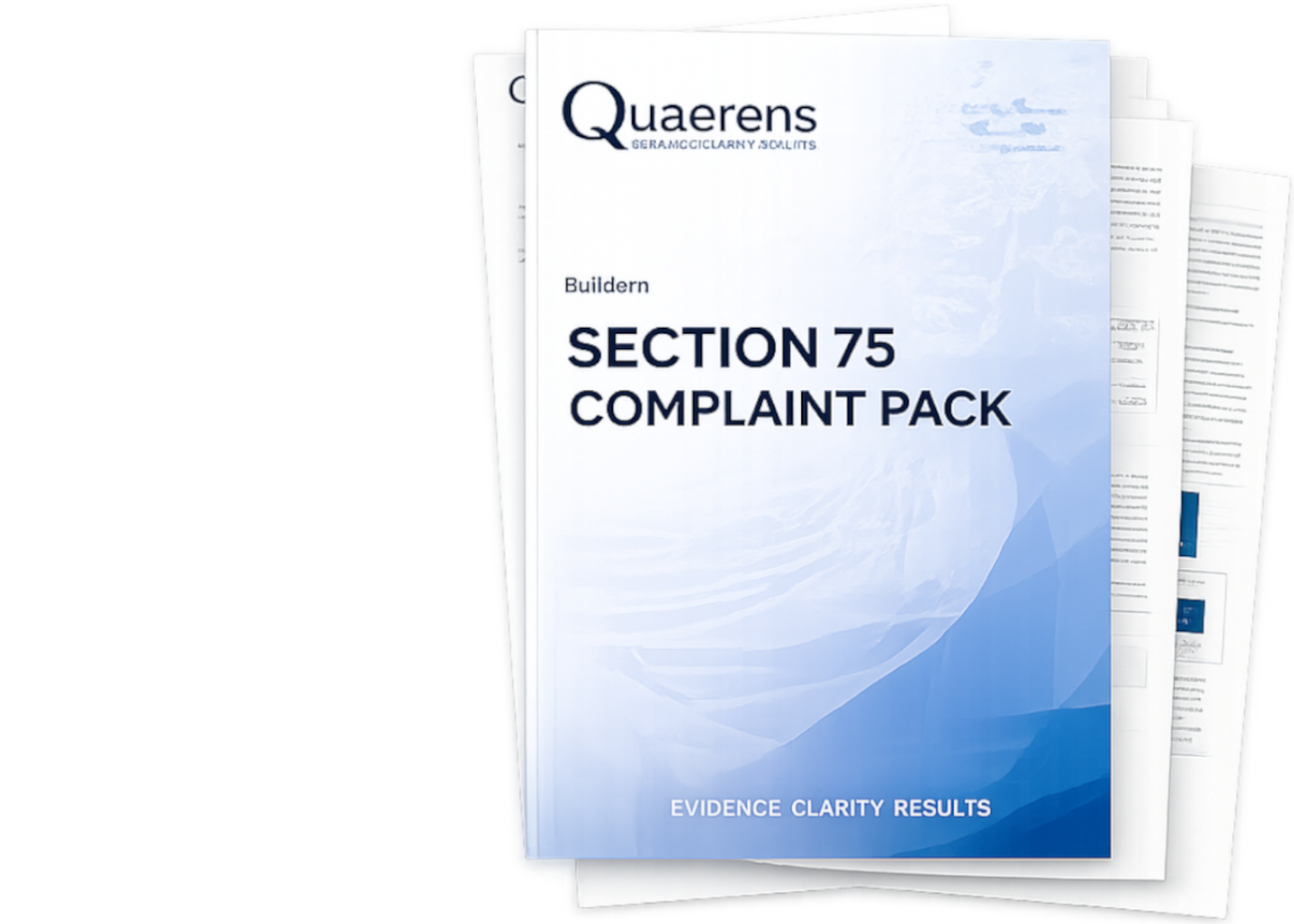
You will receive a 12-page Section 75 Complaint Pack
- Executive Summary
- Detailed Timeline
- Evidence Log & Readiness
- Financial Schedule
- Professional Complaint Letter
- Cover Email
- Submission Checklist
- Response Tracker
- Help the Next Person™ page
Free Section 75 Complaint Pack Builder™ · Framework v1.0
Build Your Free Section 75 Complaint Pack
Build a professional Section 75 Complaint Pack. Organise your evidence, generate your complaint and stay in control. Your answers remain on this device unless you deliberately download, copy, print or choose the separate Guided Support route.
Free to useNo account requiredBrowser-first privacyNo automatic submission
PurchaseProblemTimelineEvidenceFinancial LossEligibilityPack
What Is Section 75?
Section 75 of the Consumer Credit Act 1974 can make a credit-card issuer jointly liable with the supplier in some situations. In plain English, if a qualifying purchase involved a breach of contract or misrepresentation, the card provider may need to consider the complaint as well as the supplier.
The usual focus is the relationship between the customer, the credit provider and the supplier, the value of the purchase, what was promised, what was delivered, and what evidence proves the problem.
Important
Section 75 is not automatic. Eligibility depends on the purchase, payment route, supplier relationship, value, timing and evidence.
When Can Section 75 Apply?
Section 75 may be relevant where a qualifying credit-card or connected-credit purchase involves goods or services that were not supplied as promised, were misrepresented, or breached the contract.
Goods
Faulty goods, non-delivery, products not as described, missing parts, defective furniture, vehicles, home-improvement products or other purchases may be relevant if the conditions are met.
Services
Travel bookings, building work, kitchen installations, solar panels, spray foam, holiday park purchases, cancelled services or failed contractor work may need evidence review.
Misrepresentation
Sales promises, brochures, finance explanations, income projections, guarantees or claims about suitability may matter where they influenced the purchase.
Breach of contract
Evidence may show the supplier failed to deliver, supplied something materially different, refused a valid remedy or stopped trading before completing the contract.
When Section 75 Usually Does NOT Apply
A declined Section 75 complaint is often about the payment route or missing legal link rather than the underlying unfairness. These situations need careful checking:
Debit cards, cash or bank transfer
Ordinary debit-card, cash and bank-transfer payments are not Section 75 credit-card payments, although other complaint routes may exist.
Some PayPal or third-party structures
Intermediaries can complicate the direct link between card issuer, customer and supplier. The exact payment flow matters.
Outside qualifying limits
Purchase value can matter. Keep the full invoice and payment records so the total cash price and card payment can be checked.
Commercial or complex purchases
Business purchases, unclear supplier relationships, split contracts and non-consumer arrangements may require more detailed review.
What Evidence Should You Gather?
A strong Section 75 complaint usually needs a clear payment trail, supplier evidence, problem evidence and loss evidence.
- • Invoice, receipt and order confirmation
- • Credit-card statement and deposit proof
- • Contract, terms and conditions
- • Emails, letters and WhatsApp messages
- • Sales brochure, advert or website screenshots
- • Photographs or video evidence
- • Guarantees, warranties or certificates
- • Finance agreement or linked-credit documents
- • Expert, engineer or inspection reports
- • Complaint correspondence with the supplier
- • Card-provider complaint and replies
- • Timeline of events
- • Proof of losses and bank statements
- • Repair invoices or replacement quotes
- • Cancellation notices or failed delivery records
- • Final response letters
- • Ombudsman correspondence if already escalated
- • Notes of phone calls and dates
Step-by-Step Section 75 Process
1
Understand the purchase
Confirm what was bought, who supplied it, how it was paid for and the total purchase value.
2
Set out the problem
Explain whether the issue is faulty goods, non-delivery, cancelled service, breach of contract or misrepresentation.
3
Prepare supplier evidence
Keep supplier complaints, replies, refusal reasons, liquidation notices or proof that the supplier has not resolved the issue.
4
Decide the complaint route
Check whether Section 75, chargeback, supplier follow-up or another escalation route appears to fit the documents.
5
Progress with clearer wording
Send a clear complaint to the card provider with evidence, chronology and the practical remedy requested.
6
Consider escalation
Where appropriate, a financial complaint may be escalated after the card provider has had the chance to respond.
Common Reasons Section 75 Complaints Are Rejected
Poor evidence
The card provider cannot see what was promised, what went wrong or how the loss is calculated.
Incomplete documents
Missing invoices, payment records, terms or supplier replies make the complaint easier to decline.
Wrong legal basis
The complaint may describe unfairness but not clearly explain breach of contract or misrepresentation.
No clear supplier link
The card provider may dispute the connection between the payment, supplier and purchase.
Confusing chronology
Scattered dates and messages can make a valid issue look unclear or unsupported.
Unsupported financial loss
Refunds, repair costs, consequential loss or replacement costs need documents, not estimates alone.
Chargeback vs Section 75
Chargeback and Section 75 are often confused. They can both involve card payments, but they are different routes.
| Issue | Section 75 | Chargeback |
|---|---|---|
| Basis | Consumer Credit Act 1974 | Card scheme rules |
| Who reviews it | Credit-card issuer or connected lender | Card issuer through the card scheme process |
| Typical use | Breach of contract or misrepresentation on qualifying credit purchases | Non-delivery, duplicate payment, cancelled service or card transaction dispute |
| Time limits | Depends on facts and complaint route | Usually shorter scheme deadlines |
| Evidence | Contract, credit payment, supplier breach, loss and complaint history | Transaction evidence, merchant issue, proof of non-delivery or refund refusal |
Finance Agreements and Connected Lenders
Some purchases involve point-of-sale finance, linked credit or a lender connected to the supplier. In those cases, a finance-provider complaint route may need to be considered separately from an ordinary credit-card complaint.
Quaerens explains this only in general terms and helps organise documents. If specialist or regulated support may be needed, we explain that before any next step is taken.
Example Consumer Situations
These anonymised examples show common evidence patterns. They do not describe guaranteed outcomes.
Holiday park purchase
A consumer paid a deposit by credit card for a static caravan and later disputed sales promises about site fees and resale. The documents reviewed included the invoice, card statement, sales brochure, agreement and complaint replies.
Spray foam installation
A homeowner used card or finance payments for spray foam and later faced mortgage or survey concerns. The review focused on sales promises, product paperwork, lender comments and removal quotes.
Solar installation
A solar-panel customer disputed savings projections and system performance. The evidence included sales figures, finance paperwork, generation data, installer replies and repair records.
Travel booking
A travel booking was cancelled or not delivered as expected. The review looked at booking terms, payment records, cancellation notices, supplier replies and any chargeback attempt.
Furniture purchase
A furniture order arrived damaged, incomplete or not as described. Evidence included the order confirmation, photos, delivery notes, repair attempts and retailer correspondence.
Related Quaerens Support
Section 75 often overlaps with supplier complaints, finance disputes, travel claims, property disputes and complaint-letter evidence.
Spray foam payment disputes
Organise card, finance, mortgage and removal-cost evidence.
Review spray foam evidence supportHoliday park and static caravan payments
Review card, finance, site-fee and sales-promise evidence.
Review holiday park Section 75 issuesSolar panel finance and card disputes
Organise sales, finance, performance and installer evidence.
Review solar panel payment evidenceCrypto and platform payment issues
Check whether platform, bank, card or fraud evidence points to a route.
Review crypto payment evidenceConsumer complaint letters
Prepare clearer wording for suppliers, retailers and card providers.
Prepare complaint wordingFinancial disputes hub
Find banking, card, lender and finance complaint routes.
Visit the financial disputes hubConsumer Rights Hub
Refunds, complaint wording, evidence guides and escalation routes.
Visit the Consumer Rights HubTravel claims and card evidence
Organise cancellation, refund and supplier-failure travel evidence.
Review travel payment disputesProperty disputes hub
Home improvement, contractor, spray foam and solar evidence routes.
Visit the property disputes hubFrequently Asked Questions
Section 75 is part of the Consumer Credit Act 1974. In some qualifying credit-card purchases, the card issuer may be jointly responsible with the supplier if there has been a breach of contract or misrepresentation.
Possibly. If the supplier has stopped trading, Section 75 may still be relevant if the purchase qualifies and the evidence shows breach of contract or misrepresentation.
In some cases, yes. A qualifying credit-card deposit may be enough if the total cash price falls within the relevant limits and the supplier relationship is clear.
Section 75 is for qualifying credit arrangements, not ordinary debit-card payments. A chargeback route may be worth checking instead, depending on timing and scheme rules.
Yes, services may be relevant where the qualifying purchase conditions are met and there is evidence of breach of contract or misrepresentation.
It can apply to some overseas purchases, but the payment route, supplier relationship and evidence still matter. Cross-border facts should be organised carefully.
Timing can matter. The route may depend on when the purchase happened, when the issue was discovered, when you complained and any limitation or complaint deadlines.
Possibly. Connected lender or finance-provider routes may be relevant, but the agreement, parties, payment structure and complaint evidence need review.
It depends how PayPal or another intermediary was used. Some third-party payment structures can complicate the direct link between card issuer, supplier and customer.
Faulty goods may support a complaint if the purchase qualifies and the evidence shows the goods were not as described, not fit for purpose or otherwise breached the contract.
Misrepresentation can be relevant where sales material, promises or explanations were inaccurate and influenced the decision to buy. Keep brochures, messages and sales notes.
Yes, supplier silence can be part of the evidence file. Keep proof of your complaint, reminders, delivery records and any final response or lack of response.
Useful documents include the invoice, receipt, credit-card statement, contract, emails, brochures, photographs, guarantees, expert reports, complaint replies and a clear timeline.
Timescales vary by card provider, evidence quality and whether escalation is needed. A clear chronology and complete evidence pack can make the review easier to follow.
Quaerens helps organise evidence, prepare a chronology, identify gaps, structure complaint material and explain possible complaint or escalation routes. Outcomes are not guaranteed.
Optional next step
Request Guided Support
Guided Support is optional and separate from the free browser-first builder. Your answers have not been sent to Quaerens.
Guided Support unavailable
Guided Support is not currently available for this Complaint Pack. You can continue using the free Complaint Pack independently.
Prepare before you act
Build Your Professional Section 75 Complaint Pack
Organise the transaction, evidence, chronology and financial position before submitting your complaint to the card provider.
Build My Free Section 75 Complaint Pack